What I build
Workflow automation.
The manual parts of your week. The copy-paste between tools, the status update you assemble by hand, the form submission that triggers four follow-up steps you do one at a time. I wire those together so they run themselves. This is where the system goes once the Cowork setup and second brain are running underneath it, not where it starts. Ask me on the call what I have actually shipped here and what would be new ground.
The problem
You are the glue between your tools.
Your CRM does not talk to your calendar. Your form submissions land in an inbox but nobody routes them. Your weekly report pulls from three dashboards and you copy the numbers by hand. Each tool works fine on its own. The gap between them is where your time goes.
You are not missing a tool. You have plenty of tools. What you are missing is the wiring. The logic that says "when this happens, do that, then that, then that." Right now, you are the logic. You are the integration layer (and you are not getting paid for it). And that means the process only runs when you remember to run it.
What it looks like
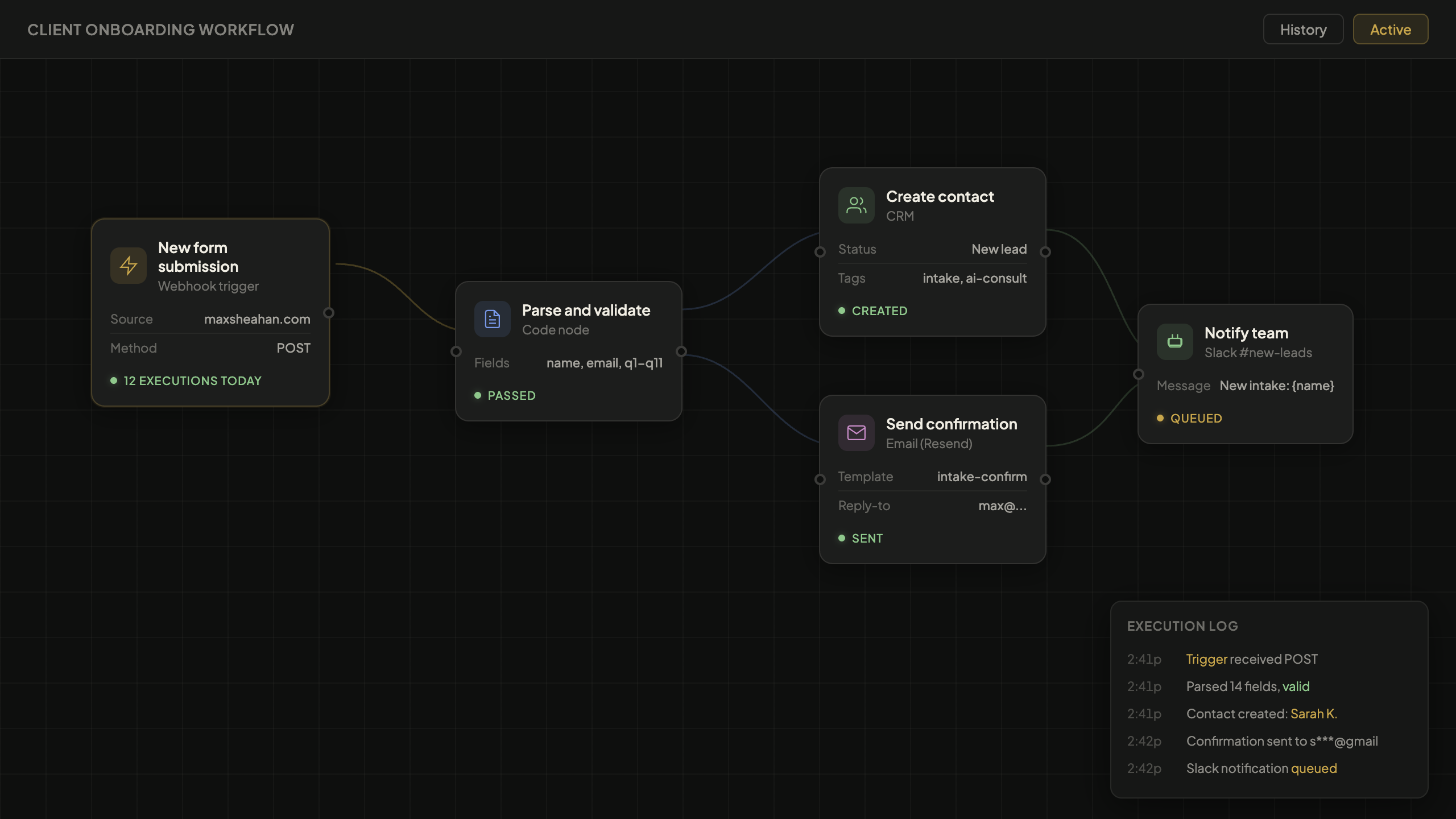
A real workflow, running.
What I automate
What I wire together.
Multi-step workflows
Form submission to CRM entry to calendar invite to welcome email. One trigger, four steps, zero manual work.
Scheduled flows
Weekly report assembly, daily digest, monthly reconciliation. Runs on a cadence you set, drops the output where you expect it.
Conditional routing
If the lead is enterprise, route to sales. If the form says "urgent," skip the queue. Logic that matches how you actually triage.
AI-augmented steps
Draft a response, summarize a document, classify an intake. Claude wired into the middle of the flow where judgment is needed.
What changes
The work shifts from doing to deciding.
The manual glue disappears
No more copying between tools. No more "I forgot to update the spreadsheet."
Processes run the same every time
The new-client onboarding, the status update, the invoice follow-up. Consistent, no missed steps.
You review, not execute
The automation does the work. You approve the output.
It scales without hiring
Ten new leads a week or a hundred. The flow handles both. No extra headcount for process work.
Stop being the integration layer.
Walk me through the part of your week that feels heavier than it should. I will tell you if it can be automated and how long it would take. I build it to run without you, and teach you to change it when your week does.
Book a call